Home / Calibration / Boom sprayer
Equipment 2 of 4, free tool, your measurements stay on your device
Boom and broadcast sprayer calibration
Quotable answer
How do I calibrate a boom sprayer?
Catch one nozzle's output for exactly 60 seconds at field operating pressure, convert that catch to gallons per minute (divide ounces by 128), time your travel speed over a measured course, then combine gallons per minute, speed in miles per hour, and nozzle spacing in inches using gallons per acre equals gallons-per-minute times 5,940, divided by speed times spacing.
Run the per-nozzle catch test
Catch one nozzle's output over exactly one minute while the sprayer is stationary and running at operating pressure, then combine that flow with your travel speed and nozzle spacing using the standard boom calibration constant, 5,940 (it converts ounces per minute, miles per hour, and inches of spacing into gallons per acre).
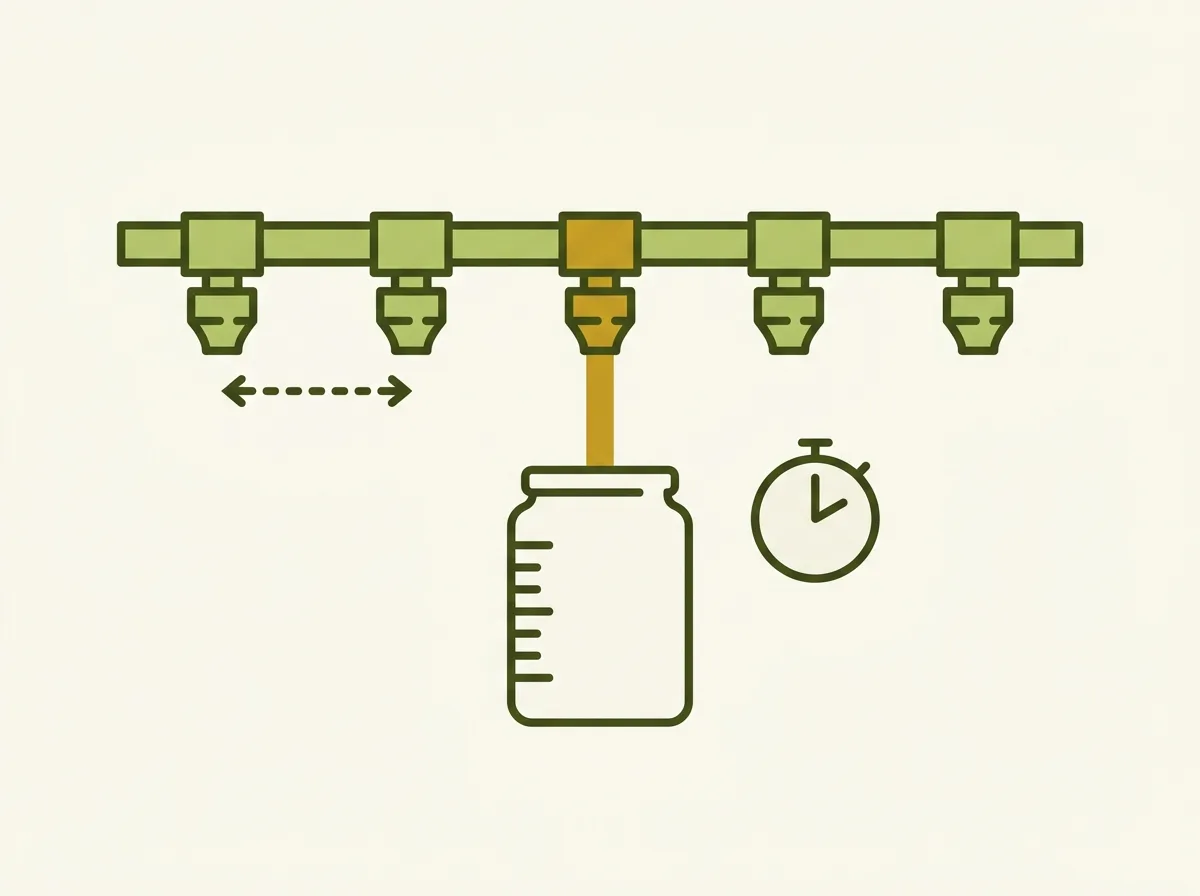
- Measure the nozzle spacing on the boom, in inches, center to center.
- Drive a measured 100-foot or 200-foot course at your actual field ground speed and time it, to get miles per hour.
- With the sprayer stationary and at field operating pressure, catch one nozzle's output for exactly 60 seconds, in ounces.
- Convert the catch to gallons per minute (divide ounces by 128), then output rate (GPA) equals that gallons-per-minute figure times 5,940, divided by (speed in mph times nozzle spacing in inches).
gpm = oz/min / 128; GPA = (gpm x 5,940) / (mph x nozzle spacing in inches)
Label-rate and mix-rate math
Enter the label's target rate exactly as it is printed, in whichever unit the label uses, and your tank size. The workflow converts to ounces of product per gallon of water and per full tank, with the unit conversion shown.
The pesticide label is the legal controlling document. This workflow is a study and field-planning aid, never a substitute for label directions. Learn more about how output rate is calculated or use the standalone mix-rate converter.