Home / Calibration / Granular spreader
Equipment 4 of 4, free tool, your measurements stay on your device
Granular applicator and spreader calibration
Quotable answer
How do I calibrate a granular pesticide spreader?
Weigh everything the spreader lays down across your swath width over a measured course length, then scale that weight up to a full acre (43,560 square feet): pounds per acre equals pounds collected times 43,560, divided by the course length times the swath width in square feet.
Run the weighed catch test
Run the spreader over a measured course at your normal setting and ground speed, catch (or sweep up) everything it puts down across a known swath width, weigh it, then scale that weight up to a full acre (43,560 square feet) to get pounds per acre.
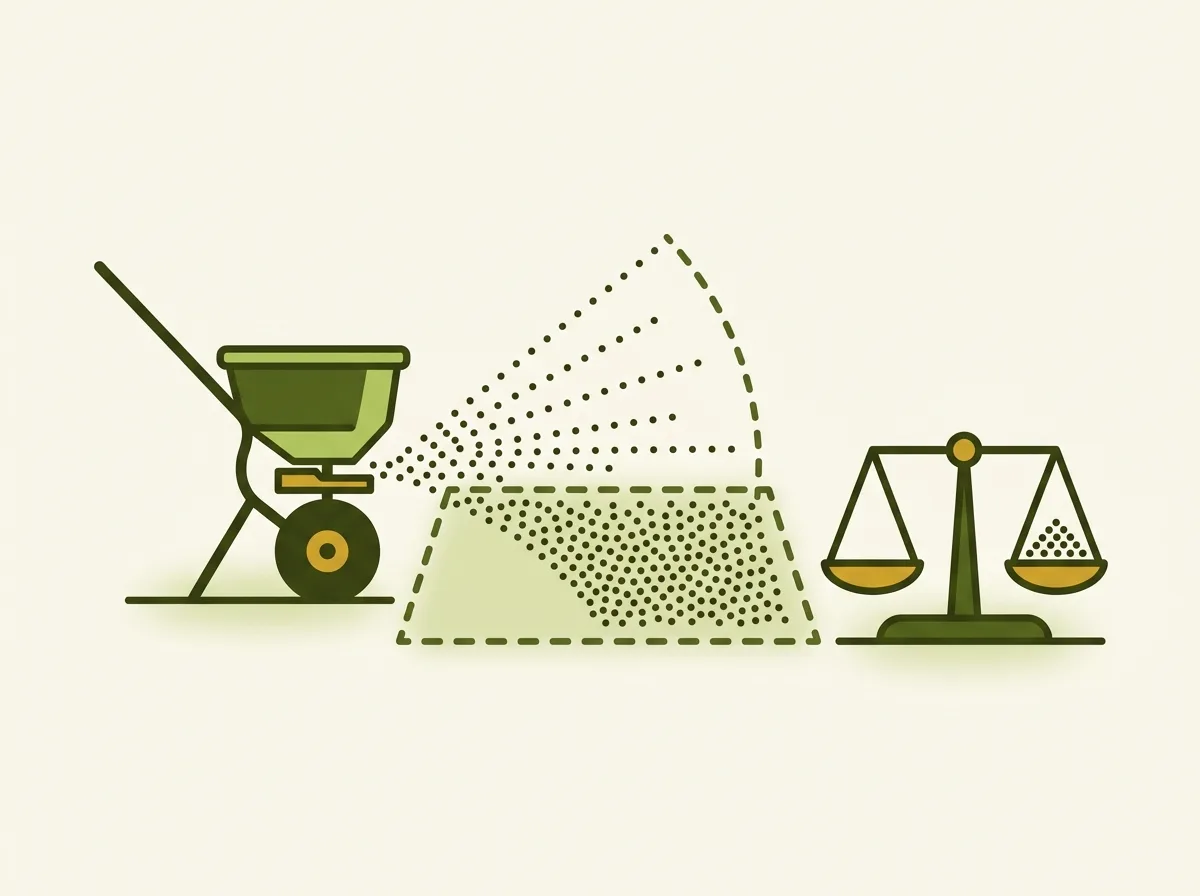
- Measure your spreader's effective swath width in feet.
- Mark and drive a measured course length, at your normal ground speed and hopper setting.
- Catch or sweep up everything applied across the swath width for that course length and weigh it, in pounds.
- Output rate (pounds per acre) equals pounds collected times 43,560, divided by the area covered (course length times swath width, in square feet).
lb/acre = (lb collected x 43,560) / (course length x swath width, sq ft)
Compare to the label's target rate and load the hopper
Enter the label's target rate and the area you plan to cover. The workflow shows how far your calibrated rate is from target and how many pounds to load for that area.
The pesticide label is the legal controlling document. This workflow is a study and field-planning aid, never a substitute for label directions. Learn more about how output rate is calculated.